Quick Read: If your doctor has recommended surgery for an enlarged prostate, you owe it to yourself to read this first. TURP — the most commonly recommended surgical procedure — is proven and effective, but it is not the only option. In this article, Dr Chen Min Qi, a vascular and endovascular surgeon practising in Singapore, explains what is actually happening inside your prostate, why leaving symptoms untreated leads to more serious problems over time, and how a procedure called PAE offers many men the same relief as surgery — without the incision, general anaesthesia, or lengthy recovery. He also covers what each treatment costs and what a visit to Singapore looks like for Indonesian patients. By the end, you will have everything you need to make this decision with confidence.

Dr Chen Min Qi, MBBS, MRC, FRCS, FAMS
The Prostate Problem Most Men Suffer in Silence
Waking at 3am to use the bathroom. Planning every outing around the nearest toilet. A urine stream so weak it tests your patience. These are the daily realities of an enlarged prostate — and yet most men endure them for years before seeking help. It simply does not feel like the kind of thing you bring up with anyone.
The medical term is benign prostatic hyperplasia, or BPH — benign meaning it is not cancer. It is one of the most common conditions men face as they age. In Indonesia specifically, the numbers are telling: around 20% of men in their forties are affected, rising to roughly half of all men in their fifties, and higher still as the decades go on.
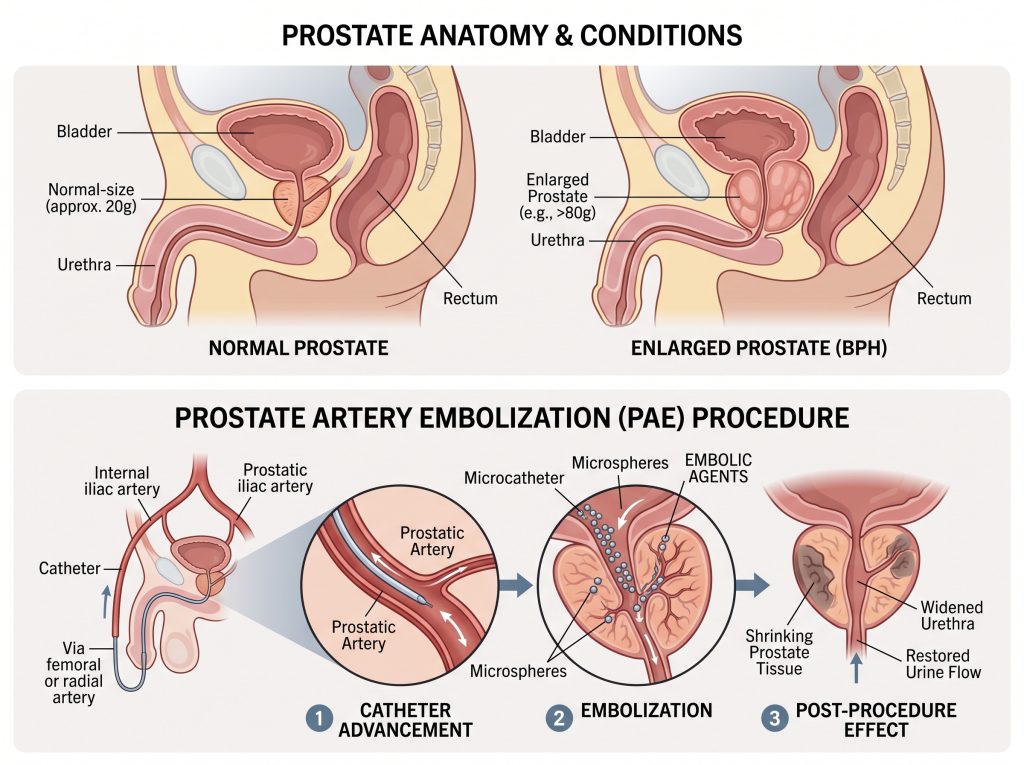
The cause is straightforward to understand. The prostate is a small gland — about the size of a walnut — that sits just below the bladder and wraps around the urethra, the channel through which urine leaves the body. As the prostate slowly grows, it squeezes that channel from all sides, making it harder for the bladder to push urine through. The bladder compensates by working harder. Over time, that is what produces the symptoms men know so well.
The most common ones include:
- A weak or slow urine stream — the flow is not what it once was
- Difficulty starting — you feel the urge but have to wait before anything happens
- Frequent urination — needing to go far more often than before, especially during the day
- Waking at night to urinate — often two, three, or four times, disrupting sleep
- A feeling of incomplete emptying — the sense that the bladder never fully empties
- Dribbling at the end — the stream stops and starts, or trails off
These are not signs of weakness or anything to feel embarrassed about. They are the natural result of an ageing prostate — and MORE importantly, they can be treated.
What Causes It — and Who Is Most at Risk
BPH is not caused by cancer, and it is not caused by anything you have done. It is a benign, natural overgrowth of prostate tissue, driven primarily by the hormonal changes that come with age. Age is by far the strongest risk factor — the older a man is, the more likely he is to be affected.
That said, some men are more prone to it than others. Risk factors include:
- Age — the single most important factor, with risk rising sharply after 40
- Family history — having a father or brother with the condition increases your likelihood
- Obesity — carrying excess body weight
- Diabetes and high blood pressure — often present together as part of metabolic syndrome
- A sedentary lifestyle and a history of smoking
What Happens When You Leave It Too Long
BPH is not life-threatening in itself, but the ongoing blockage causes progressive damage, and that damage compounds the longer treatment is delayed.
Here is how it progresses if left unmanaged:
- Repeated urinary tract infections — bacteria thrive in urine that is not being properly emptied from the bladder
- Bladder stones — minerals crystallise in the stagnant urine the bladder cannot clear, causing pain and further blockage
- Acute urinary retention — the bladder becomes completely blocked and you are unable to pass urine at all. This is a medical emergency requiring immediate catheterisation — usually in a hospital
- Bladder muscle damage — years of overwork weaken the bladder wall, and it may eventually lose its ability to contract properly, even after the blockage is relieved
- Kidney damage — in long-standing, severe cases, the backed-up pressure can cause irreversible harm to the kidneys
Medication can slow the progression — but it does not remove the blockage. For men whose symptoms have been building for years, or whose tablets have stopped working, a procedure is often the point where treatment makes the most meaningful difference. The earlier that decision is made, the more of the above can be avoided.
Your Treatment Options — Honestly Explained
Treatment for BPH is stepped — most men start with the least invasive approach and only escalate if needed. Dr Chen Min Qi describes the journey this way: begin gently, and move forward only when the evidence says it is time.
The three levels of treatment are:
- Lifestyle changes and monitoring — for mild symptoms, reducing evening fluids, cutting caffeine and alcohol, and staying active can provide meaningful early relief
- Medication — alpha blockers relax the muscle around the bladder neck to improve flow; 5-alpha reductase inhibitors slowly shrink the prostate over months. Both are useful but require ongoing use, and some men find their effectiveness fades over time
- A procedure — when medication no longer provides adequate relief, or when symptoms are clearly affecting quality of life and sleep
When a procedure is needed, there are two main paths — and understanding the difference between them is what this article is really about.
TURP — The Traditional Surgical Option
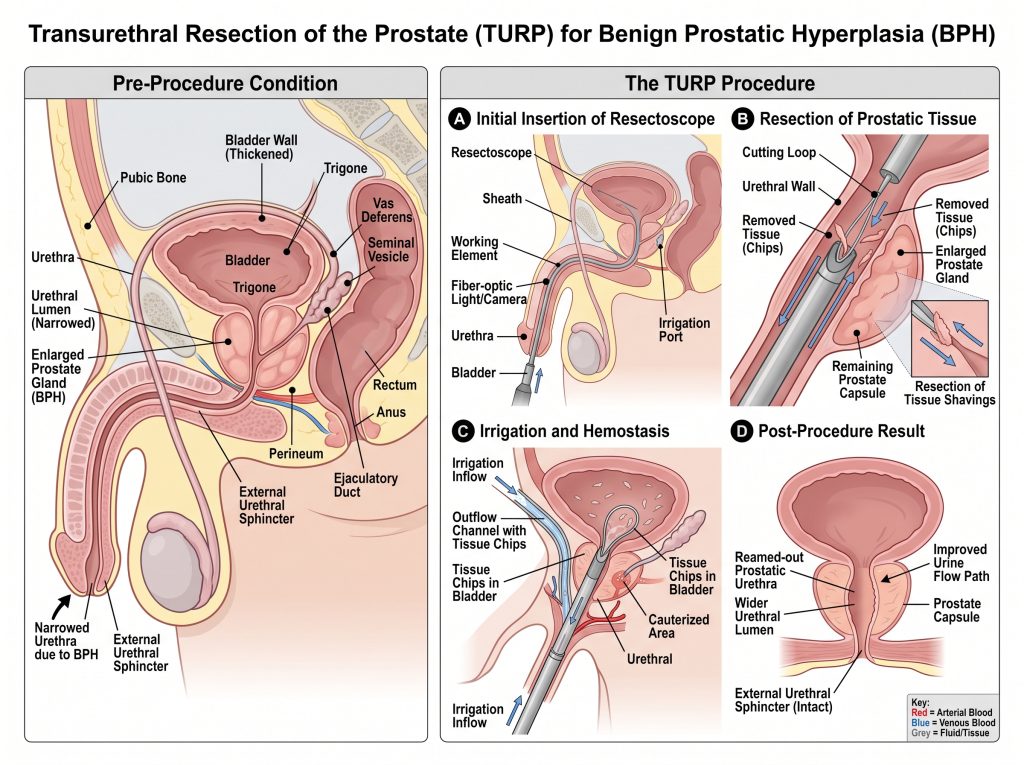
TURP (transurethral resection of the prostate) is the long-standing surgical standard for BPH. A surgical instrument is passed through the urethra to physically cut away and remove the prostate tissue causing the blockage. It is effective, durable, and has a long track record. For men who need the strongest and most immediate relief, and who are fit for surgery under general or spinal anaesthesia, TURP remains an excellent choice.
PAE — The Minimally Invasive Alternative
PAE (prostate artery embolisation) takes a completely different approach. Instead of cutting tissue, a thin catheter is guided through a small entry point in the wrist or groin into the arteries supplying the prostate. Microscopic particles are then injected to reduce blood flow to the prostate, causing it to gradually shrink. No incision, no tissue removal, and in most cases no general anaesthesia.
Dr Chen Min Qi performs PAE as part of his specialised endovascular practice. For many of his patients — particularly those who want to avoid surgery, who value a fast recovery, or who are concerned about the effects of TURP on sexual function — PAE has become the treatment that offers real relief with far less disruption to their lives.
PAE vs TURP — A Clear Comparison
| PAE | TURP | |
|---|---|---|
| How it works | Shrinks the prostate by reducing its blood supply | Removes blocking prostate tissue through the urethra |
| Invasiveness | Minimally invasive, tiny entry point, no incision | Surgical procedure |
| Anaesthesia | Usually no general anaesthesia | General or spinal anaesthesia |
| Hospital stay | Day procedure or short overnight stay | Overnight to short inpatient stay |
| Recovery | Light activities within 1–2 days | 4–6 weeks before strenuous activity |
| Symptom relief | Good — builds gradually over weeks as prostate shrinks | Strong and more immediate |
| Durability | May need re-treatment more often over time | Long track record, lower re-treatment rate |
| Sexual function | Better preserved — lower risk to ejaculation | Higher chance of affecting ejaculation |
| Very large prostates | Well suited, including when surgery is not ideal | Effective but technically more demanding |
What Recovery Looks Like
Recovery is often what concerns men most — especially those travelling from Indonesia who need to plan their time away carefully.
After PAE:
Most men go home the same day or the day after, and return to light daily activities within one to two days. There may be mild pelvic discomfort, slightly more frequent urination, or a low-grade fever for a few days while the prostate settles — this is expected and temporary. Symptom relief builds gradually over four to eight weeks as the prostate shrinks. For patients travelling from Indonesia, most can plan a Singapore stay of three to four days.
After TURP:
A urinary catheter is usually needed for a few days. Most men are advised to avoid strenuous activity and heavy lifting for four to six weeks, with full recovery taking up to six to eight weeks in some cases. The relief is more immediate, but the recovery window is significantly longer — an important consideration for anyone travelling for treatment.
Why Patients Choose Singapore — and What It Costs
PAE is still not widely available across Indonesia, and the outcome is closely tied to the experience of the surgeon performing it. Singapore’s healthcare system operates under strict national standards, and endovascular specialists here are trained and accredited to international benchmarks. For a procedure that depends on precise, image-guided catheter technique — performed inside arteries millimetres wide — that depth of experience matters.
A realistic cost guide for treatment in Singapore:
- Initial specialist consultation: SGD 218 (approximately IDR 3 million)
- Imaging and assessment (CT angiography or ultrasound): SGD 500–1,000 (IDR 5.8–11.5 million)
- PAE procedure: SGD 12,000–18,000 (IDR 138–207 million), depending on complexity
- TURP: SGD 8,000–15,000 (IDR 92–172 million), depending on hospital and duration
An upfront cost estimate can be provided before you travel. Send your existing medical records or imaging to the clinic, and the team will give you a preliminary figure before you confirm your visit. There is no obligation to proceed.
The Vascular & Interventional Centre provides Bahasa Indonesia-speaking support throughout — from your first enquiry to follow-up care after you return home.
About Dr Chen Min Qi — Vascular & Endovascular Surgeon, Singapore
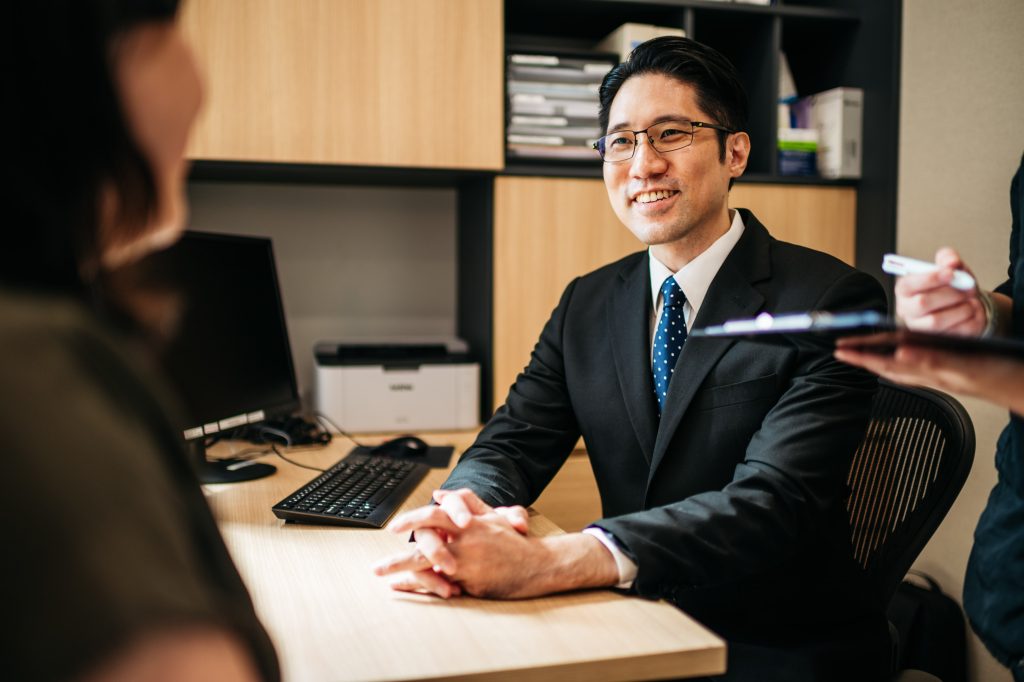
With over 2,000 endovascular procedures to his name, Dr Chen Min Qi brings a level of subspecialty experience in minimally invasive, image-guided procedures that is uncommon in the region.
His background:
- Medical degree from the Yong Loo Lin School of Medicine, National University of Singapore (NUS)
- Advanced vascular subspecialty fellowship at St Mary’s Hospital, London — one of the world’s leading vascular centres — funded by the Singapore Ministry of Health’s Health Manpower Development Plan (HMDP) scholarship, awarded to a select few surgeons each year
- Former Head of Vascular Service at Woodlands Health, leading multidisciplinary teams managing complex vascular cases and surgical service development
- Clinical tutor at both NUS and NTU medical schools, and peer reviewer for the International Wound Journal
- Specialist in procedures not routinely offered regionally, including PAE for enlarged prostate, uterine artery embolisation (UAE), pelvic vein stenting, and vascular treatments for erectile dysfunction
His clinic, the Vascular & Interventional Centre, is equipped with a dedicated hybrid operating theatre for complex endovascular work — the kind of facility that allows procedures like PAE to be planned and performed with the precision imaging they require, all in one place.